SPACEEEMARS BEES MISSION · BIG ASS MARS LEGACY
BATCH 01LIMITEDMISSIONOPENRESERVE
OPEN RESEARCH RESOURCE · VERSION 1.0

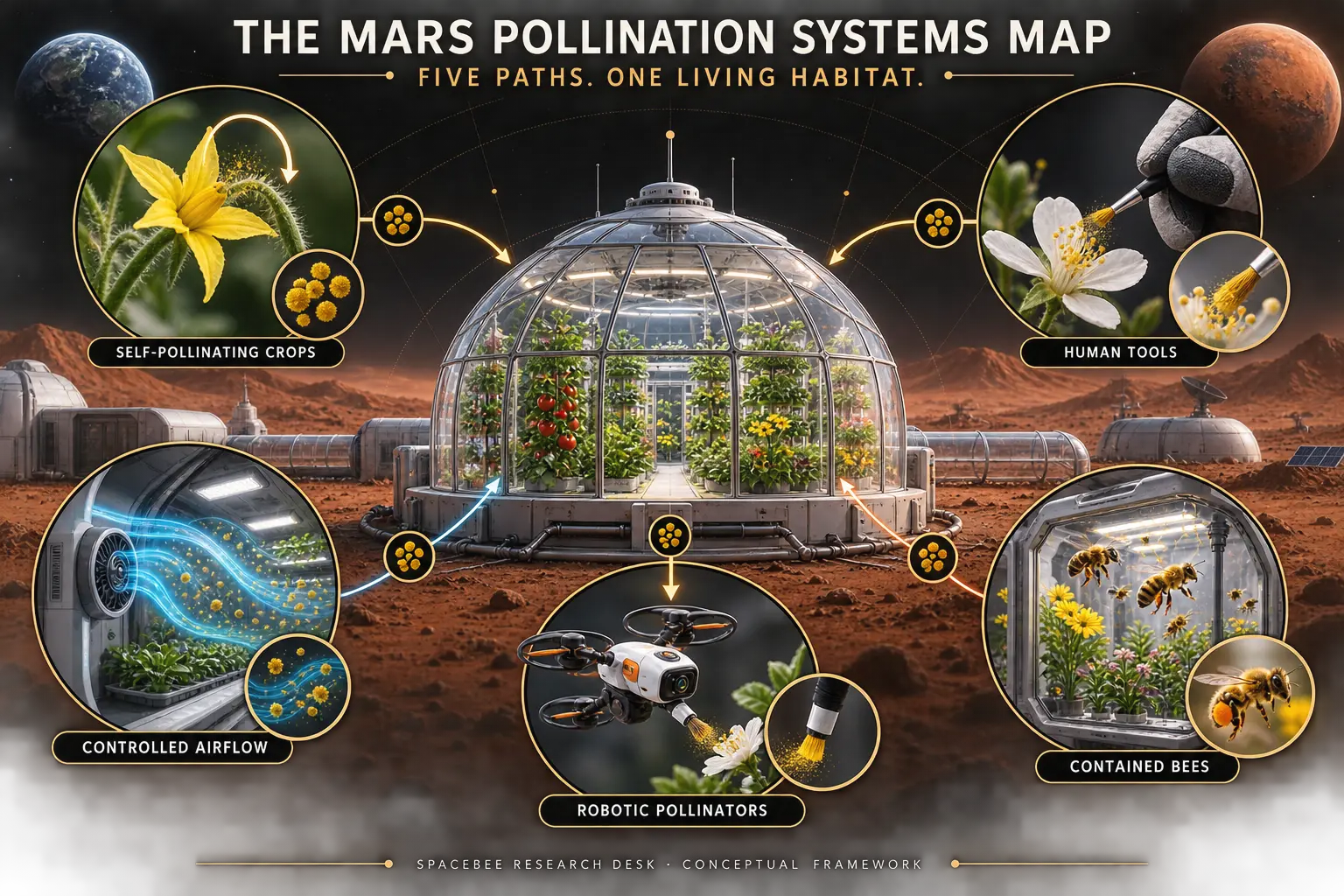
The Mars Pollination Systems Map

Five possible pathways for flowering crops inside a protected habitat. No single method wins every mission phase.

Diagram comparing self-pollinating crops, human tools, controlled airflow, robotic pollinators and contained bees inside a Mars habitat
SPACEBEE Research Desk conceptual framework. Not a finalized Mars habitat design.
01

SELF-POLLINATING CROPS

Low complexity for selected crops; not every plant can use this path.

02

HUMAN TOOLS

Precise and practical at small scale; requires crew time and repeatable access.

03

CONTROLLED AIRFLOW

Useful for compatible crops; must be designed alongside atmosphere and humidity control.

04

ROBOTIC POLLINATORS

Controllable and monitorable; adds hardware, maintenance and software dependencies.

05

CONTAINED BEES

Distributed biological behavior; adds colony welfare, nutrition and containment requirements.

The most credible answer may be all five.

Early crews may prioritize self-pollinating crops, human tools and controlled airflow. Robotic systems may reduce repetitive work. Carefully contained biological pollinators become relevant only when crop diversity, habitat scale and ecological ambition justify their additional complexity.

The map is intentionally a comparison framework, not a prediction. Its purpose is to help researchers, students and science-fiction worldbuilders ask what each method requires, what can fail and where redundancy matters.

Use and citation

You may reference this framework for editorial, educational and noncommercial discussion with attribution to “SPACEBEE Research Desk — Mars Pollination Systems Map, Version 1.0.” The image may not be presented as NASA, SpaceX or university research.