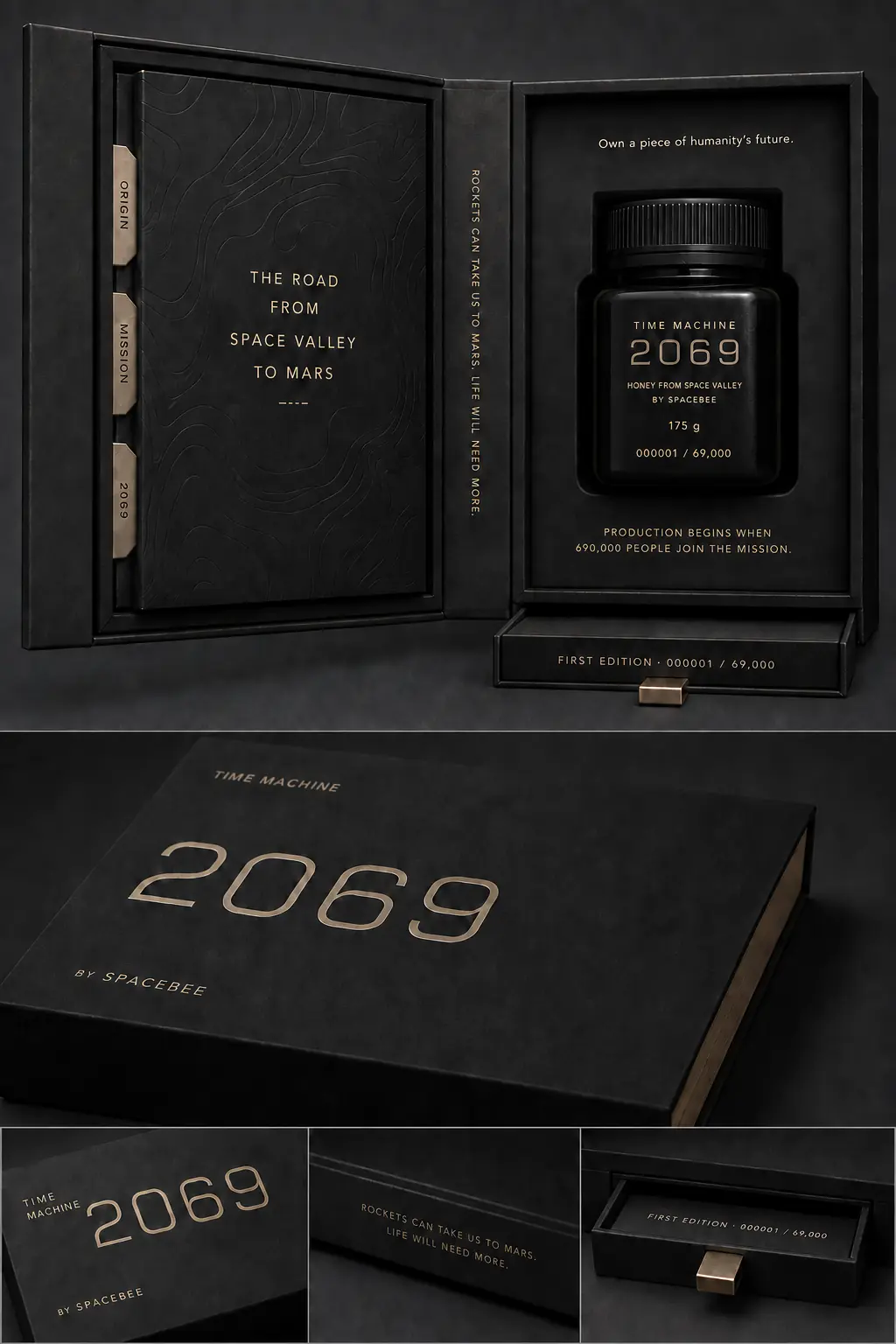
Let us remove the illusion immediately
THE MARS LEGACY ARTIFACT honey does not come from the planet Mars. This honey was made on Earth. No flower opened inside a Martian habitat. Anyone selling that claim today would be selling fiction as fact.
Rare earth’s Mars Hadramout honey comes from SPACEBEE's desert origin in Hadramout, Earth’s Mars, the landscape the project calls Space Valley and Mars Desert.
Then why put Mars on it?
Because THE MARS LEGACY ARTIFACT is not pretending to be the final achievement. It is a marker placed at the beginning. The jar asks its owner to remember what existed before the first documented honey could ever be made in a protected Mars habitat.
That makes the contradiction the point. Rare earth’s Mars Hadramout honey carries a Mars ambition. An old biological substance becomes evidence of a future community.
Two jars. Two worlds. One comparison.
Rare earth’s Mars Hadramout honey gives THE MARS LEGACY ARTIFACT its first reference taste. Nobody can truthfully know how honey made on Mars will taste before it exists.
If Mars redemption becomes available in 2095, the second jar gives another generation the chance to compare Rare earth’s Mars Hadramout honey with honey made on Mars. The uncertainty is not a weakness in the artifact. It is the reason the two jars matter.
The label must remain honest
A beautiful myth becomes dangerous when the customer cannot tell where the poetry ends. SPACEBEE should always state the origin plainly: Hadramout, Earth’s Mars, on Earth.
If Mars honey is ever made, it will need a separate chain of evidence, documented habitat conditions and independent scrutiny. Until then, THE MARS LEGACY ARTIFACT belongs to the beginning, not the destination.
Why people may still fight about it
Some people will call this visionary. Others will call it theatrical packaging. Both reactions are useful because the artifact is designed to force a question: what proof would convince you that a biological future on Mars has genuinely begun?
That debate is more valuable than an impossible claim. It gives the audience something to argue about without asking them to believe a lie.
Sources and further reading
NASA Mars facts ↗FAO pollination resources ↗How this article was created
The SPACEBEE Research Desk framed the question, reviewed public primary sources, stated the strongest counterargument and separated evidence from hypothesis. AI assisted drafting may be used for structure and language. Claims are manually reviewed before publication. No unnamed expert endorsement is implied.
Read our editorial, corrections and scientific review policy →