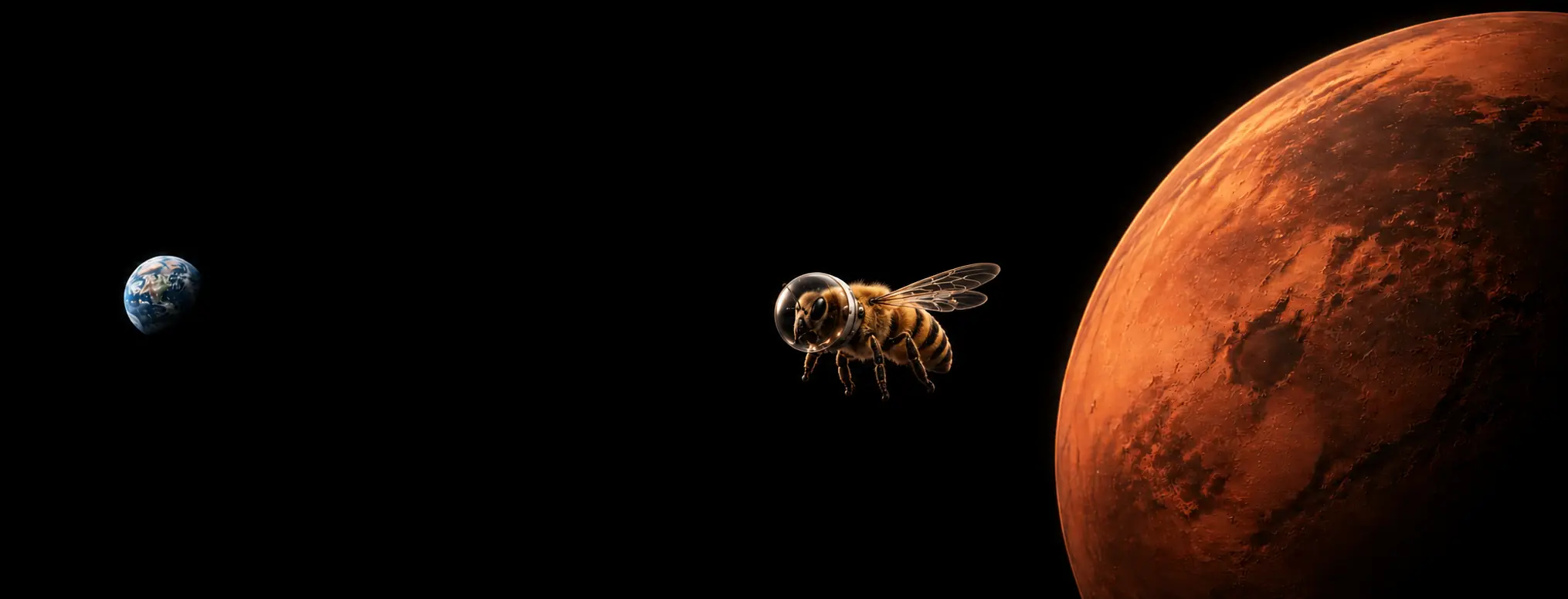
The argument nobody wants to make
Most Mars architecture begins with rockets, radiation shielding, oxygen and power. Insects arrive much later, if they appear at all. That order makes sense for the first crews. It may be dangerously incomplete for the first permanent society.
A settlement is not truly alive because humans can survive inside it. It becomes ecologically resilient when plants reproduce, waste becomes input, microorganisms cycle nutrients and many living agents perform overlapping jobs. On Earth, insects are part of that invisible infrastructure.
A robot can move pollen. That is not the whole job.
Hand pollination, airflow and robotic systems can fertilize selected crops. They may be the safest choice in an early habitat. But pollinators do more than touch one flower. They move through irregular spaces, respond to scent and color, and connect thousands of small biological events without a central control system.
The honest question is not whether a robot can pollinate a tomato. It can. The question is whether a growing settlement should depend forever on a narrow chain of machines, spare parts and programmed behaviors for every reproductive event in its food system.
Why bees are a brutal test
Bees are not an easy passenger. They require nutrition, water, temperature control, nesting conditions, orientation cues and protection from contaminants. That difficulty is exactly why honey is an unusually powerful systems test.
If a protected habitat can support flowering plants, bee navigation, pollination, colony health and surplus nectar processing, several living systems have worked together. Honey would be the visible output of an invisible ecological machine.
What SPACEBEE is claiming, and what it is not
SPACEBEE has not produced honey on Mars and has not demonstrated a Martian hive ready for flight. The work begins on Earth with desert bee observation, questions about controlled habitats and future testing with qualified partners.
The controversy is a design challenge: should Mars be built as a machine that keeps humans alive, or as the beginning of an ecosystem? SPACEBEE believes the second future deserves to be tested now.
Sources and further reading
NASA Veggie plant growth research ↗NASA: Space crops and food systems ↗FAO: Pollinators and food production ↗How this article was created
The SPACEBEE Research Desk framed the question, reviewed public primary sources, stated the strongest counterargument and separated evidence from hypothesis. AI assisted drafting may be used for structure and language. Claims are manually reviewed before publication. No unnamed expert endorsement is implied.
Read our editorial, corrections and scientific review policy →